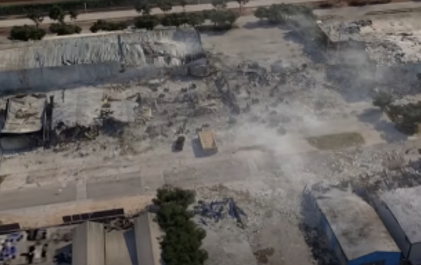
The US Chemical Safety Board (CSB) has released a safety video on the investigation into a fatal release of propylene gas that resulted in the death of two workers and one local resident, and damaged over 450 neighbouring structures. A simple risk management system, safe operating procedures and emergency response training could have prevented this catastrophic incident.
WorkSafe’s Major Hazards Matters | July 2025 features this case study that highlights the importance of employers following basic regulatory requirements when working with hazardous substances.
The Watson Grinding and Manufacturing Company in Houston specialised in machining and grinding services as well as applying high performance coatings – particularly High Velocity Oxygen Fuel (HVOF) coatings which extends the service life of metal parts used in highly corrosive environments such as specialised chemical mining and aerospace equipment.
Inside the coating building at Watson Grinding were eight individual coating booths – six booths were used for HVOF coating, a process that involves the use of propylene, a highly flammable hydrocarbon gas. Propylene was piped into the coating building from an outside storage tank located in a separate area of the facility.
On the day of the incident in January 2020 operators shut down the individual coating booths and a supervisor closed and locked the coating building. There was no established procedure for isolating the storage tank at the end of the day. Neither the manual shut off nor the remote shut off valves were closed.
At some point during the night a degraded and poorly crimped rubber hose disconnected from its fitting inside one of the coating booths and propylene was able to freely flow from the storage tank into the coating booth. The rubber hose had been used to replace a more robust copper tubing. Rubber hosing is not recommended for propylene service as the oils in propylene can cause the hose to perish, form cracks and lose pliability.
The coating building was equipped with an automatic gas detection system with wall-mounted gas detectors inside each booth. In the event of a gas leak the system would alert operators to a leak, start extraction fans and trigger remote shut off valves to stop the flow of gas. Several years prior to the incident Watson Grinding had disconnected the gas detectors from the computer control system rendering the system useless.
Around 3:30am when two employees arrived on site to use the site gym, one of them could smell what he believed to be propylene outside of the building. They both went to investigate and outside the coating building they detected a strong propylene odour and could hear a hissing sound. They returned to the gym and texted the supervisor and plant manager. Neither the supervisor nor the manager advised the employees to evacuate the area. One of the employees decided to investigate further. At 4:09am the supervisor texted both employees to advise them not to start up work yet. At about 4:23am a coating booth operator with a key to the coating building arrived and entered the building. When he turned on the lights the accumulated gas ignited causing a massive explosion. The operator and the employee who first noticed the leak were killed and a nearby resident died two weeks later as a result of injuries sustained in the blast.
The CSB investigated and found two safety issues that contributed to the incident – a process safety management system and emergency preparedness. Contractors visiting the site in 2013, 2016 and 2019 had raised concerns in writing about the disconnected gas detectors, but although Watson Grinding management had discussed the issue, no action was taken. The company had not retained the engineering drawings and documentation and did not train its employees to use or maintain the system effectively. The company also did not perform a hazard analysis on the propylene system or assess the risks when choosing to replace the copper tubing with the rubber hose.
Although Watson Grinding had a written emergency response plan in place at their site, the plan did not address the hazards of propylene or discuss how to respond to a leak. They also did not formally train their employees to recognise or respond properly to a propylene leak and did not have periodic drills. As a result, the employees did not evacuate the area, did not prevent others from entering and did not contact emergency services for help.
Following the incident Watson Grinding filed for bankruptcy and ultimately closed, leaving 130 employees without a job. The identified failings of Watson Grinding that led to this multiple fatality and the destruction of a significant part of the surrounding community could have been remedied relatively quickly and inexpensively. Doing things the right way can be significantly less costly than doing them the wrong way.
- Regularly test and assess safety and alarm systems
- Ensure that safety audit and inspection findings are followed up promptly
- Conduct a risk assessment in consultation with employees for all changes to work systems
- Provide appropriate levels of training to all employees
- Conduct regular emergency and evacuation drills for all employees
Read more: No Detection: Explosion at Watson Grinding | USCBS YouTube