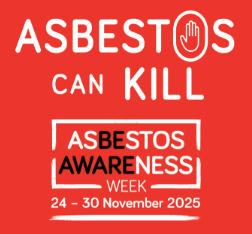
This year, National Asbestos Awareness Week (NAAW) 2025 will be held from Monday 24 November – Sunday 30 November.
Since 31 December 2003 asbestos has been a banned substance in Victoria. The ban includes the importation, use, and manufacture of all forms of asbestos, and marked a significant milestone in the effort to protect public health from the risks associated with asbestos exposure. Products that were manufactured after this time should not contain asbestos. However, imported products from certain countries may still contain asbestos, due to differing regulatory environments.
On 31 December 2016 the Victorian Asbestos Eradication Agency (VAEA) was established to plan and prioritise the removal of asbestos from government-owned buildings in the state. The workplace asbestos registers of all government-owned buildings were consolidated, an evidence-based risk model was developed to assess asbestos hazards along with best practice materials and guidance, and the work continues to remove the identified asbestos.
Outside of government-owned buildings we know that there are still privately-owned sites with asbestos present, particularly in buildings built before 1990. The Victorian government Asbestos page offers tools to guide you through the process of finding and identifying asbestos around your home or workplace and provides practical guidance on how to manage or remove it.
But homes and workplaces are not the only environments where asbestos may be found. It is important to understand the myriad of ways in which asbestos and asbestos containing materials have been used and where we might encounter them (you can find a list of pre-2003 asbestos-containing materials here). Asbestos can show up in brake pads and gaskets, in old railway sleepers, in old hair dryers and fire blankets, and over the past week we have seen it reported in children’s coloured and kinetic sand.
Last week, the Australian Competition and Consumer Commission (ACCC) issued a national recall notice for coloured sand products following laboratory testing that detected traces of asbestos, prompting the temporary closure of a number of schools across the country, particularly in ACT. Testing on ACT schools where the sand products have been used are showing that respirable asbestos has not been detected in any of the tested samples. The release of respirable asbestos fibres from the coloured sand is unlikely to occur in its current state, unless the sand is processed by mechanical means such as crushing or pulverising.
The products included in the recall were manufactured in China and imported into Australia before being sold by local suppliers to retailers.
Regardless of where or in what form asbestos is encountered it is important to be aware of the correct procedure for removal and disposal of the product. WorkSafe offers a checklist of duties and responsibilities when removing asbestos, as well as the Compliance Code: Removing asbestos in the workplace. For asbestos identified outside of the workplace the Victorian government Asbestos site offers advice on how to contain the hazard and find a licensed asbestos removalist to assist you.
Read more: Aust Gov | Recall of coloured sands – November 2025