Until the 1940s safety was basically a trial-and-error endeavour – in 1941 the National Safety Council (NSC) in the US began in-depth examinations into the causes of fatal occupational incidents and seeking a better way to describe effective controls. In 1950 the NSC began describing a safety system known as the Hierarchy of Controls (HoC).
Referral to the HoC has long been standard practice for how Australian employers manage the health and safety of employees and meet their legal OHS obligations. This model has been invaluable in developing strong controls for physical workplace hazards.
With the development of regulatory material on psychological risk management, there have been concerns that the traditional HoC is not fit for purpose to manage psychosocial hazards, hazards that result from work systems or hazards with complex causes, such as musculoskeletal disorders.

The traditional HoC system prioritises elimination as the first goal. It then ranks substitution and engineering controls as the next most effective, and administration and PPE controls as less reliable and impactful. If employers cannot eliminate hazards and risks, then they must work through the hierarchy from top to bottom and select controls that most effectively reduce the risk.
Suggested revisions of the HoC have proposed modifying the levels of the hierarchy and defining non-hierarchical controls within levels. Examples such as the one below break controls into higher and lower levels.
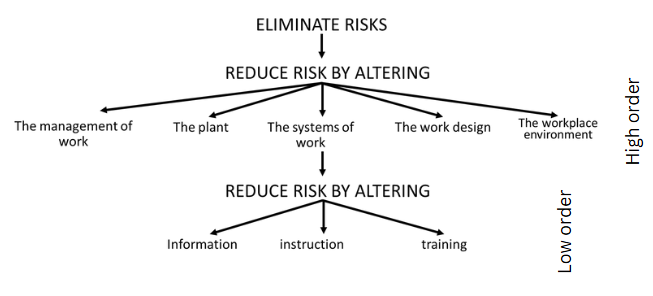
Researchers at La Trobe University’s Centre for Ergonomics and Human Factors have expanded further on this approach with a new version that they call the Work Systems Hierarchy of Controls (WS-HoC).
Whilst the researchers agree that the conventional HoC is better suited to managing individual physical hazards such as dangerous chemicals or working at heights, they say that their new WS-HoC ‘Re-design Work Systems’ level (below) provides clarity when managing hazards caused by systems of work and shifts focus to redesigning work and systems.
The ‘Individual Actions’ level emphasises how individuals support the implementation of the re-designed work and systems.
The preferred option of ‘Eliminate the Hazard’ remains unchanged at the top of the WS-HoC.
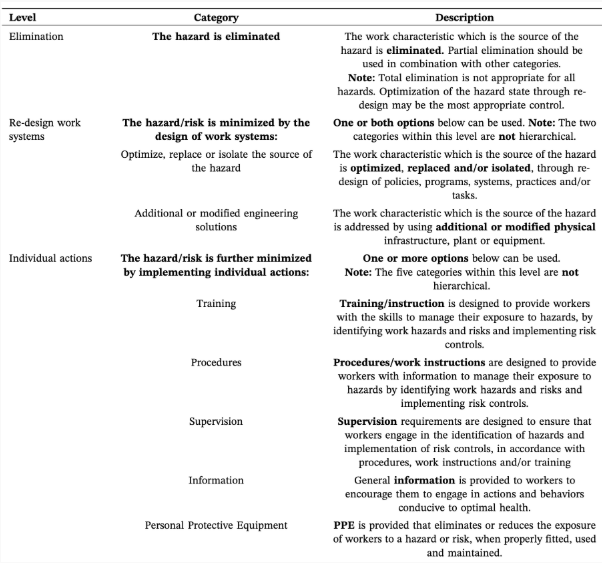
Within the Re-design Work Systems and Individual Actions levels of the WS-HoC the researchers propose non-hierarchical categories to assist employers to conceptualise various options within the levels in no specific order. They say that this WS-HoC is designed to "highlight the importance of the re-design of systems of work in which people are key, reducing the chance that these useful risk controls would be misclassified as lower order, administrative controls and then discounted as ineffective".
The researcher applied their new WS-HoC to 79 risk controls previously developed to address physical and psychosocial hazards related to the musculoskeletal health of paramedics, to test the utility of the tool in a real-world context. The controls transferred to the new model well, with most being classified in the Re-design work systems level.
The exercise highlighted the importance of clear definitions and guidance, and the importance of work re-design as a control measure. This study provides a strong starting point for our regulatory bodies to re-develop our existing HoC to reduce the chances of useful risk controls being misclassified as lower order, administrative controls that may then be discounted as ineffective.