Hi Renata – a DWG member has asked me to support them in a meeting with HR. They had reported that another worker was bullying them and management advised that personal conflicts should be managed by HR. We work for a large organisation in the public sector, and I feel that this issue is more widespread than just this individual. What can I do as their HSR?
While HR may have a role in managing interpersonal complaints, bullying and harassment are recognised psychosocial hazards under Victorian OHS legislation and your employer must manage the hazard under OHS law. This means:
- The employer has a legal duty under s.21 of the OHS Act to provide and maintain a working environment that is safe and without risks to health — including psychological health.
- Framing bullying as a "personal conflict" minimises the OHS obligation and could be an attempt to shift responsibility away from the employer.
- Under the OHS (Psychological Health) Regulations 2025 your employer has a duty to identify, assess and control psychosocial hazards, which includes bullying — this is not optional.
As an HSR you have significant powers and rights. Under s.58 of the OHS Act you can:
- Investigate complaints from members of your DWG
- Inspect the workplace (including the psychosocial work environment)
- Accompany and represent your DWG member at meetings
- Be consulted by the employer on health and safety matters
Your employer also has duties and obligations toward you. At s.35 of the OHS your employer must consult with you as the HSR when:
- Identifying hazards (including psychosocial hazards like bullying)
- Making decisions about risk controls
- Proposing changes to the work environment
Consultation doesn’t just mean telling you what they have decided. Consultation must involve:
- Sharing relevant information
- Giving you a reasonable opportunity to express views
- Taking your views into account
Speak with your DWG member and let them know that you can attend the meeting as their support person. You have the right to represent and support your DWG member, to take notes and keep detailed records, and to ensure that the process is fair, respectful and confidential.
When speaking with your employer about this matter you can reframe the issue as an OHS matter. Raise that bullying and harassment are psychosocial hazards under OHS laws and that the employer has a duty to identify and control those hazards. This is not simply a personal conflict and requires a proper OHS risk management approach.
Ask your employer to:
- Conduct a risk assessment of the psychosocial hazards reported
- Consult with you as the HSR on control measures
- Implement appropriate risk controls (not just mediation between individuals)
- Ensure no victimisation of the worker who reported the issue
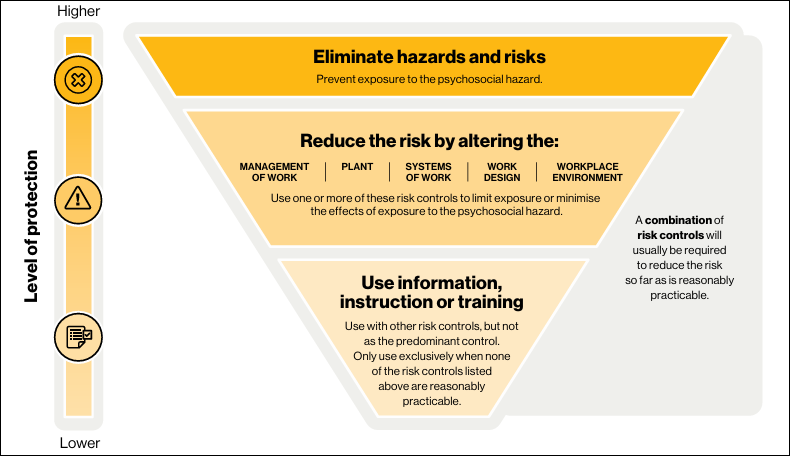
It is important to note when developing controls to manage psychosocial hazards that, if your employer cannot eliminate the hazard, they must reduce it by altering the management of work, plant, systems of work, work design, work environment, or using information, instruction or training, or using a combination of those controls - the image above illustrates this hierarchy of controls. However, Information, instruction or training may only exclusively be used as a risk control measure where none of those other risk control measures are reasonably practicable. Where a mix of controls are used, information, instruction or training cannot be the predominant control measure.
The Psychological Health Compliance Code has a list of example risk controls for bullying on page 69 that includes enabling “OHS and Human Resources (HR) teams to work together when investigating reports of bullying. This will help to identify all psychosocial hazards contributing to bullying behaviour and control any associated risks”.
Document everything – ask your DWG member to help you record the complaint details, dates and specific behaviours, as well as your employer’s response. Encourage them to keep a diary of incidents – you could use our Bullying Report Form
You are right to question whether this is a systemic issue rather than an isolated incident. Research consistently supports this – bullying is rarely just about one person and often is accompanied by other workplace factors like high job demands, poor support or low role clarity as this WorkSafe Fact Sheet makes clear. You may consult with your DWG members and/or conduct an anonymous survey to understand the extent of the problem.
If your employer insists that this is an HR issue you can raise it formally as an OHS issue under the provisions of s.73 Resolutions of health and safety issues using your workplace’s formal incident/hazard reporting system. If they still fail to address their OHS duties in relation to this issue you can:
- Issue a Provisional Improvement Notice (PIN) under s.60 of the OHS Act
- Contact your union for further advice and support
- Contact WorkSafe Victoria to report the hazard
You may also want to note that your DWG member may also have rights under the Fair Work Act, anti-discrimination and/or equal opportunity laws, depending on the nature of the harassment.
If you have any questions about OHS we encourage to fill out an Ask Renata query and one of our officials will get back to you shortly. Alternatively give Ask Renatabot a try!