Hi Renata – My DWG have roles that require them to handle a powdered product and the safety data sheet (SDS) identifies it as a Category 2 – Suspected Human Carcinogen. Our employer provides us with P2 masks when using this product, but DWG members are reporting to me that they are finding the product under their masks, in their nose, mouth and throat after use so obviously the product is breaching their masks. This is because the only P2 mask that is provided does not conform to their face well.
I have requested that employees using this product be given access to fit testing services to identify the best masks for their face, but I am getting pushback from management.
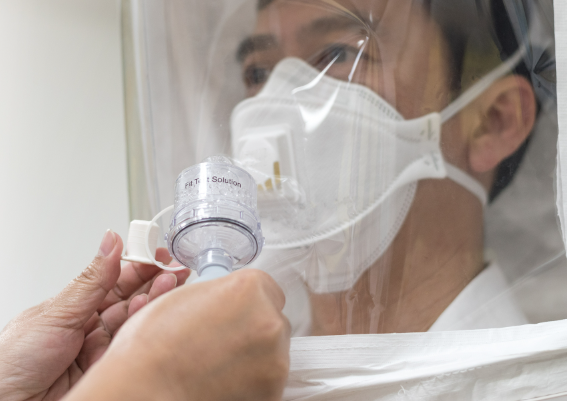
The point of being required to wear a mask is to prevent the suspected carcinogen being inhaled or ingested, A mask that fails to do this is not an adequate control. It is worth noting that PPE is the lowest form of control on the hierarchy. We are confining our advice to this because of your question but encourage you and your DWG to think about higher order controls that can control the risk more effectively.
It is reasonable to request that your employer provide fit testing to ensure that employees are provided with the most appropriate P2 mask for use when performing tasks using that product. To work safely and effectively all PPE, including respirators, must be the correct size and fit for each individual. Staff must have access to appropriate PPE resources and receive information and training regarding how to correctly put on (don), wear/use, take off (doff), and dispose of PPE in different situations.
As we learned during the pandemic not all masks are equal, and not all masks fit all faces. To work effectively against air-borne particles masks must be the correct type, model and size for each individual as assessed by fit testing. Health care facilities, hospitals etc. engaged fit-testing staff during the pandemic to ensure that the PPE provided for staff protection was given the best chance of being effective.
As your colleagues and DWG members are finding particles of the product under their masks and in their noses and throats, it is clear that the one-size-fits-all approach of your employer is not adequately protecting staff. It is entirely reasonable to request fit-testing, education/training to ensure correct mask usage and fit checking, and the provision of a variety of masks to ensure a proper fit for all face types.
Your employer has a duty at s.21 of the OHS Act to manage any risks in the workplace to either eliminate the hazard or reduce the risk presented by the hazard, so far as is reasonably practicable.
When we look at how the OHS Act defines ‘reasonably practicable’ we see at s.20 of the OHS Act that in determining what is reasonably practicable in relation to ensuring health and safety, employers must consider the following –
- the likelihood of the hazard or risk concerned eventuating – we know the likelihood because your DWG members are reporting it
- the degree of harm that would result if the hazard or risk eventuated – the product SDS tells us the potential degree of harm is serious
- what the person concerned (the employer) knows, or ought reasonably to know, about the hazard or risk and any ways of eliminating or reducing the hazard or risk – your employer has a duty to know about the hazards to which they expose employees, and they are able to read the SDS themselves
- the availability and suitability of ways to eliminate or reduce the hazard or risk – fit testing protective masks is a well-known, cost-effective and reasonable control
- the cost of eliminating or reducing the hazard or risk
The WorkSafe publication How WorkSafe applies the law in relation to Reasonably Practicable states that when it comes to the cost of implementing a safety control, there must be a clear presumption in favour of safety. The question of what is reasonably practicable must be determined objectively – not by reference to the duty-holder’s capacity to pay.
Your employer also has a duty to consult with you (and any other employees/HSRs affected or likely to be affected by this issue) in assessing and controlling this hazard. Section 35 of the OHS Act and the WorkSafe publication Guide to Part 7 - Employee representation handbook for workplaces clearly define when your employer must consult and what that consultation should look like.
I recommend that you speak with the HSRs of other DWGs that are affected by this issue, conduct a risk assessment on the task and develop a plan to address this collectively. Formally request that management consult with you all about this matter – you can use this Consultation Email template - and be sure to keep a record of everything that is said and agreed to - Record of Consultation.
I also urge you to contact your union directly for support in resolving this matter.
If you have any questions about OHS we encourage to fill out an Ask Renata query and one of our officials will get back to you shortly. Alternatively give Ask Renatabot a try!