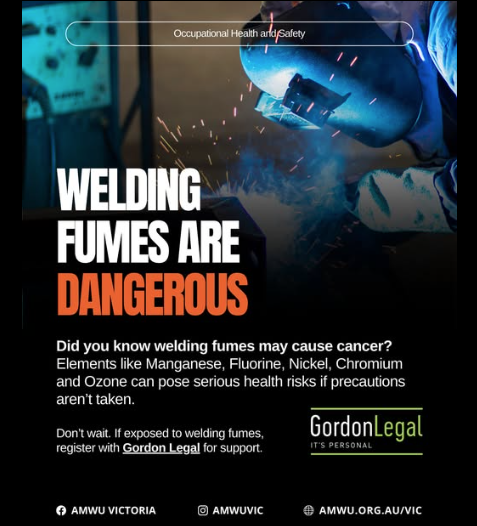
Thousands of workers across the country – like fitters, welders and boilermakers – weld every day and are exposed to carcinogenic welding fumes. Workers who don't weld but are around welding are also exposed to those fumes.
Having a recorded history of exposure to welding fumes in the workplace can assist you to access workers’ compensation if you develop an illness or disease that is causally linked to welding fumes. To this end, the Australian Manufacturing Workers’ Union (AMWU) helped to create a Welding Fume Register to help workers record their exposure history.
The AMWU was active in the campaign for the reduction of the workplace exposure standard (WES) for welding fumes that came into effect in January 2024, lowering the limit from 5mg/m3 to 1mg/m3. In November 2025 the WES for aluminium welding fumes were reduced by the same amount, bringing it into line with general welding fume exposure standards.
Welding fumes have been classified as a Group 1 carcinogen (known to cause cancer in humans) since 2017 and are also known to cause other serious illnesses such as lung damage and emphysema. Elements like manganese, fluorine, nickel, chromium and ozone are released during the welding process and can pose serious health risks if precautions are not taken.
Manganese, in particular, has ototoxic properties, meaning that inhalation of the fumes can have a toxic effect on the ear and its nerve supply, leading to hearing loss and is exacerbated by concurrent exposure to noise. This is recognised in the proposed changes that would come into effect on 1 December this year with the transition from the current chemical workplace exposure standards (WES) to workplace exposure limits (WEL) by the inclusion of ototoxicity notations in the WEL list.
Whether a worker goes on to develop fume related or ultra-violet related illnesses or diseases after exposure to welding fumes, the benefits of having a recorded history of that exposure is invaluable. Better still, is to ensure that our workplaces eliminate or reduce our exposure as much as reasonably possible.
Employers have a responsibility under the Occupational Health and Safety (OHS) Act to provide a safe workplace through the elimination or reduction of exposure to hazards. Where elimination of welding fumes is not reasonably practicable there are processes and safety equipment, such as Local Exhaust Ventilation (LEV) units and Powered Air Purifying Respirators (PAPR) masks, to ensure workers are protected from inhaling the dangerous fumes.
Employers can also access free information and guidance about their OHS duties regarding welding hazards at WorkSafe:
- Exposure standards and atmospheric monitoring
- Controlling Exposure to Welding Fumes
- Preventing exposure to welding fumes webinar
- Controlling exposure to ultraviolet (UV) radiation when welding
- Local exhaust ventilation preventative maintenance
If you or someone you know has been exposed to harmful welding fumes, it is important to take action. Record your exposure information at the Welding Fumes Exposure Register. For more information or assistance about welding fumes, call the AMWU Safety Unit at 9230-5700.
Read more: AMWU Victoria | Welding Fume Register